A Kickstarter Postmortem for Adventures in the Public Domain
kickstarter finances post mortemAt the end of last summer, I ran my first Kickstarter.
I've been writing and self-publishing material for tabletop roleplaying games for a few years and I wasn't entirely happy with the model of bootstrapping it and then selling them via DriveThruRPG. If I wanted to commission the level of art and production that I felt was necessary, I would basically be guaranteeing substantial loss right out of the gate.
I was reluctant to run a Kickstarter before I had produced a couple of books. I remember reading The Sine Nomine Guide to Kickstarter Management a few years ago. I internalized the message of: know at least how to get a book laid out, printed, shipped, listed on all the sites, a PDF delivered, art created/licensed, all that. I have a process of doing all that now, maybe not the most optimized, but I am organized and have a legitimate little pipeline happening.
The other issue is the fact that I don't use social media except for a reddit account that I nearly never use. So I have no "following" just a few hundred customers on DriveThruRPG and Itch.
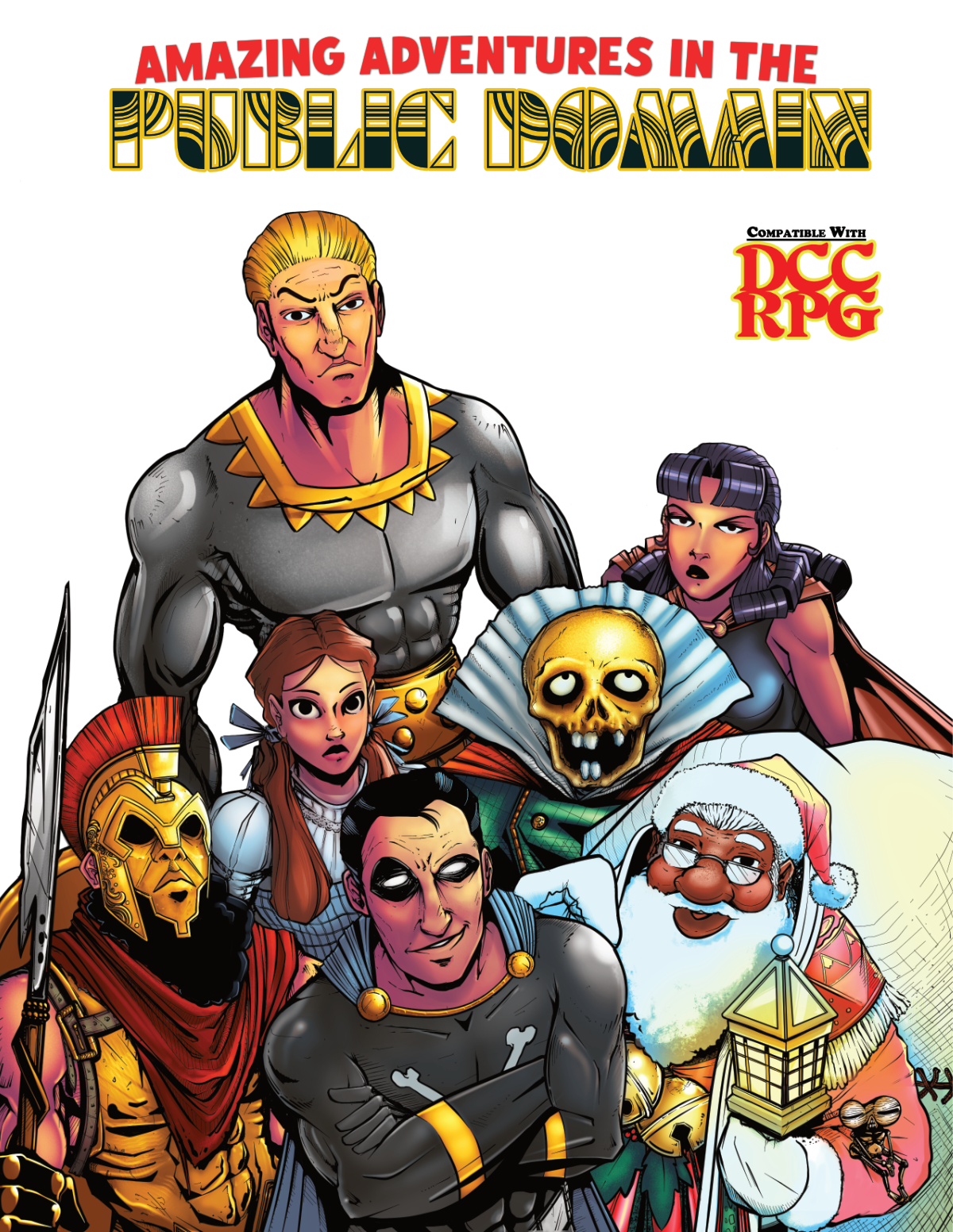
This led me to set my goal low. I commissioned a cover on spec for $150 from my usual and very talented collaborator, Gino Vasconcelos, a low price but since he is a long time friend as well as a regular collaborator, he was willing to do that for the promise of more illustration when the book was complete.
(It's a homage to a classic Justice League cover from my personal favorite era of the comics, thanks Kevin Maguire)
The Numbers
On a goal of $333, I raised $845 over the campaign and via late pledges! Not bad. It's slightly more than the total sales of my previously highest selling book.
After Kickstarter's fees, $845 became 759.14. I also collected shipping fees via Kickstarter's built in pledge manager, collecting in total $338.37. My total collected then is $1097.51.
Folks pledged not only for the book, but also back copies of my previous work. Most people pledged at the Print + PDF level.
Here's a cost breakdown of the Kickstarter, as accurately as I can get it:
| Description | Cost | Total | Remainder of original 1097.51 |
|---|---|---|---|
| Cover | 150.00 | 150.00 | 947.51 |
| Interior art | 250.00 | 400.00 | 697.51 |
| Proof copy | 10.13 | 410.13 | 687.38 |
| Print run of 140 | 430.13 | 840.26 | 257.25 |
| POD backlist add-ons | 49.30 | 889.56 | 207.95 |
| Boxes for shipping | 54.32 | 943.88 | 153.63 |
| Pirate Ship | 322.65 | 1266.53 | -169.02 |
In the end a loss of $169.02. Which is... ok. Obviously, I'd like to be pocketing a big payday but that isn't really why I write tabletop roleplaying games about Stardust the Super Wizard.
What did we learn?
One: Making these is just expensive. I got a deal on the art, I recognize that, and it was still one of the biggest bites out of possible profits. And the thing is, I don't intend to make books with less art going forward. Art sells books. If you can't buy less art, it seems you just have to sell more books. It also is the most fun part of making these, seeing Gino (or whomever) take a few sentences and build it into something cool.
Two: Possibly printing too many. I printed 140 and sold about 60 print copies. This was largely to get to the next printing tier at Mixam, and I expect to gradually sell off the rest in subsequent Kickstarters, but it's possible I should have just ordered what I needed, plus a few extra and paid for subsequent print runs as necessary.
Three: Additional quality control is needed. I received feedback about some stuff I overlooked almost immediately, and it has held up my release of the print on demand version of the book, where I might recoup some of this overage. It's hard because as you can see, I really don't have budget for proofreading, so I may look to my personal network for volunteer work on this front.
Four: Overcharging for shipping. The books could have been sent media mail, but I charged for and paid for ground advantage. If I wasn't in such a hurry, I could have done this more intelligently. I collected $338 in shipping but spent $322 on Pirate Ship plus $54 on boxes — nearly breaking even, when media mail would have left a surplus, or let me charge folks less (which is what I would have done, let's be honest).
Five: Selling print on demand books for too small of a price. I made no money on these. My most expensive to print & lowest selling book will not be an add-on in future Kickstarters, and future crowdfunding will help finance print runs of backlist books that continue to sell as add-ons.
Six: Kickstarter's pledge manager was very difficult to extract clean information from. This could be a skill issue, but what I wanted was one hundred packing slips, plus a list of emails to send out digital rewards. I ended up spending a whole day in CSV hell trying to figure it out. I wrote a little utility in Bun for next time. I'll probably open source it once I do a dry run with it.
Seven: Multiple digital fulfillment fronts. I fulfilled PDFs via DriveThruRPG, Itch, and my Shopify website Cthulhu Dice. This proved to be time-consuming and almost no one chose Itch or DriveThru.
Next
Some of this can just be chalked up to "first time for everything." I had a budget to begin with but didn't quite get it right; going forward, I will be able to more accurately predict the cost of crowdfunding a book and have a better idea about what a sensible cushion is.
I've sold around $50 of PDFs on DriveThruRPG in the first month of its public release. Hopefully a little spike when the POD comes out, and we will be close to break-even.
I launched my follow up project (This Rose Will Never Die & Sisterhood of the Splintered Bone on Backerkit) almost immediately. It's doing better than the first Kickstarter (over $1000 raised with a week to go), hopefully because my audience is growing and not because of Backerkit's natural aggression.
I didn't implement everything I learned, in fact, I've already dropped a bunch of money on stickers that probably didn't sell any books at all. See note above about the fun part. I think after a second round of crowdfunding and fulfillment, I will have a tighter, more cohesive, and less money-losing system, and hopefully, people like what we produce so that I continue to sell slightly more books each time (and can spend more money on art, stickers, fancier printing, etc).
- Next: What do coders do after AI?
- Previous: Nobody Gets Promoted for Simplicity